|
Cabin
Crew as a Career
based
on an article by www.careerintravel.co.uk
Cabin
Crew Requirements
Information on cabin crew and what they do
Working
a Flight as a Cabin Crew Member
An overview of a typical flight.
Applying
To Be A Cabin Crew Member
A brief look at interviews and how the airlines make their
selections.
Cabin
Crew Salaries
What kind of salary can you expect
.
Once
Recruited As A Cabin Crew Member
An insight into what to expect once you have been recruited as
cabin crew and the training the airlines will provide for you.
The
Highs And Lows Of Working As Cabin Crew
10
Reasons To Become A Cabin Crew Member
Cabin
Crew are primarily on board an aircraft for the safety and welfare of
the passengers. They are required to understand and operate all cabin
safety equipment such as medical and fire-fighting apparatus. Since this
is seldom required, Cabin Crew fulfil the additional role of providing
customer service and ensuring passenger comfort. Because cabin crew
members are one of the main faces of an airline they are expected to
excel in customer service and always remain friendly, approachable and
enthusiastic with a good sense of self presentation. The role of cabin
crew is physically demanding and you must be prepared to be flexible to
work any day of the year. Cabin Crew encounter many different situations
whilst working on board an aircraft and must be excellent team players
with the ability to work on their own initiative using quick thinking
and organisational skills.
Its
3.30 in the morning. Your alarm goes off and its time to get up for your
flight to Nairobi, which is due to depart at 7.00am. You attend to your
bathroom rituals, put on your uniform and make sure your appearance is
immaculate (Even at 4.00am in the morning!). Cabin Crew need to check in
up to 2 hours prior to flight departure, so you will need to report for
work (in the briefing room) at about 5.00am. You arrive at base, park in
the car park and head for the briefing room. Dawn is just about to
break.
You
sign in, check your notices and messages, and check your cabin manual to
refresh yourself with the emergency procedures and location of emergency
equipment for the aircraft you are operating on. You go into the
pre-flight briefing and the senior crew member talks you through the
flight details. This will normally include the order in which the
services will operate for the flight, your responsibilities for the day
and if there are any passengers with special needs flying e.g. you may
be given the responsibility to explain the emergency facilities to a
blind passenger on the particular aircraft you are operating on. You
should also be prepared to be asked questions regarding safety and
emergency procedures.
Now
the crew are ready to proceed to the aircraft, and may do so either on
foot or by crew shuttle bus. You will need to complete the necessary
customs and immigration formalities before boarding. On entering the
aircraft you will move to your position and prepare to start work.
BEFORE
THE PASSENGERS BOARD
It’s
now time for you and your team to check your emergency equipment, that
you have enough meals, drinks and duty free for the passengers, stock
all the toilets with the necessary hand towels and tissues. Now the
passengers are on their way, this is your final chance to check that
your uniform is immaculate and presentable, all that’s left to do is
smile and greet the passengers on board (bearing in mind its 6.30am in
the morning). Remember you are the face of the airline so smiles are
essential throughout the whole flight.
In
Preparation of Take Off All the passengers are now seated and the
aircraft pushes back and prepares to taxi to the runway. It is now time
to perform the safety demonstration so passengers can familiarise
themselves with all the aircraft's emergency facilities. This will
include pointing out the available emergency exits and lighting, the use
of oxygen masks, seat belts and life jacket. You will complete your
demonstration by checking through the cabin ensuring seatbelts are
fastened and loose articles are secure for take off. You will now take
your seat for take off.
DURING
THE FLIGHT
Once
the aircraft is airborne you will be released from your seat. You will
perform your duties as discussed in the pre-flight brief. The order of
services varies from one airline to another. Some services may be
charged for. This includes the sale of headsets for the in-flight
entertainment, drinks and duty free goods.
Typical
services which can be offered are the following:
-
Headsets
for the in house entertainment
-
Drinks
service
-
Meal
service - including special request meals for some passengers
-
Tea
& Coffee
-
Cold
towels offered to passengers to freshen up after their meal
-
Clearing
& collecting the meal trays from the passenger
-
Duty
free goods
-
Immigration
cards
-
Preparing
the cabin for landing.
During
this time you must also remember to check the toilets every 20 minutes
to make sure that they are clean and stocked up.
You
might have to deal with a number of questions and queries, but most
importantly you need to maintain the safety and comfort for all of the
passengers. Some passengers may have more flights under their belt than
you do and therefore require careful handling.
LANDING
AT NAIROBI
You
now take your seats for landing. Once landed you say goodbye to the
passengers and then prepare the aircraft for its return journey. (This
is referred to as the turnaround). Duties to perform during the stop
include restocking the bars for the drinks service, restock and check
the catering, restock all the toilets, take out any rubbish from the
seat pockets and ensuring all passengers have reading literature i.e.
airline magazine, safety card, in-flight sales brochure and a sick bag.
Before your new passengers board you will have to complete a security
check to ensure no one has left any items on board as this is obviously
taken very seriously. Last but not least check your appearance before
the new passengers arrive. The passengers arrive so once again you have
to greet them and assist where needed. When they are all seated its time
to begin the same emergency briefing and cabin service all over again!
LANDING
AT BASE AND END OF FLIGHT CHECKS
Once
you have landed back at your base airport and the passengers have
disembarked, its time to go back to the crew centre to count the money
and to make sure that the amount of goods sold throughout the flight
balances with the amount of cash you have taken. Once this has been done
its time to check your file for any changes to your future flying
programme and then you are free to go home. Congratulations - you have
completed a thirteen-hour day and you will feel like you have walked to
Nairobi and back! GOODNIGHT!
With
air travel still growing very fast, and the world becoming an ever
smaller place, people are now realising that there are alternatives to
the normal 9-5 routine and are looking towards careers such as
cabin crew as more fulfilling with the opportunity to travel the world.
This has generated a lot of competition for Cabin Crew positions, and
consequently airlines are able to be rather selective about who they
employ. Typically less than 10% of those who apply will be offered a
position.
When
airlines look for possible new recruits to work as cabin crew they have
to make sure that the people they employ know exactly what would be
expected of them, have all of the right qualities needed and will be
dedicated to the airline. This is because an airline will spend
significant sums of money on each new entrant for their uniforms,
training and development. The airlines therefore do all they can to
ensure that they recruit the right people.
On a
typical airline screening session there could be up to 250 prospective
candidates attending per day and they are subjected to a rigorous
selection process. The assessors will give the applicants written tests,
group work and the opportunity to present themselves to others to
evaluate how they are suited for the role. Airlines particularly prefer
people that go to the interview with an awareness of what the role of
cabin crew is all about and those who have taken an interest in the
airline that they have applied to. They must be able work well in a
group and that have a friendly, confident and caring nature. Good
communication skills, both written and verbal, are a must.
The
starting salary for a new recruit is entirely dependent on geographic
location. Starting salaries are from USD 1200 per month. With allowances
this could be almost doubled. In certain locations accomodation is
provided. Usual company perks such as medical insurance and pension are
also available. Salaries increase as you obtain more experience, and
promotion to management is also possible for those who excel.
Once
you have been successfully accepted by an airline to work as a cabin
crew member you will have to complete a mandatory 4-6 week training
course which is governed by the Civil Aviation Authorities. This
training course is sometimes called SEP (Safety & Emergency
Procedures) and is usually paid for by the airline (plus you will also
get your first month’s wages).
The new
low-cost airlines prefer to cut cost by employing ready-trained crew, in
which case the applicant would have to fund his or her own safety
training before applying for a position.
During
this time you will be trained on:
Some
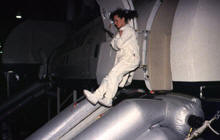
of this training can be conducted within different simulators to
practice the drills and procedures needed to deal with different types
of emergencies. Because this training is extremely expensive it is only
offered to people recruited as cabin crew, however there are airline
recognised training courses available which would give you an excellent
insight into what you can expect. Once you have successfully completed
the SEP training you will then be put on a probationary period from 3 to
6 months where your performance will be assessed by senior cabin crew
and airline trainers. Also every cabin crew member has to undergo
recurrent training every 12 months and be re-tested.
There
are many highs to being a cabin crew member and most current cabin crew
would say that they definitely outweigh the lows. So what are the highs
to working as cabin crew:
-
No
two flights are the same - you meet different people everyday. These
range from babies right up to the elderly - and passengers can be
fun.
-
You
can get cheap flights for friends and family depending on the
airline, you will be amazed how quickly your friends come out of the
woodwork! Imagine going to Mauritius for a couple of days, just to
top up your tan.
-
If
you fly abroad then as crew you can purchase duty free goods.
-
Time
off patterns are different to almost any other job. You may work for
4 or 5 days and then have 3 days off, sometimes even 5 if you have
been put on standby and have not been called in to work!
-
When
working as cabin crew you gain self-confidence and have a great
sense of achievement. You will acquire knowledge of many languages,
cultures, and customs.
-
For
the lucky ones that do long haul flights then you will often stop
over in the country you are flying too. You stay in 4 or 5 star
hotels and have some time off whilst you are there.
Well,
as with any job there are a few lows as well:
-
You
are obliged to work any day of the year and at any time. Weekends
tend to disappear. You may have to work on your Birthday or
significant holidays.
-
It
can be tiring work - you can be delayed and the days can be long.
There are many overnight flights.
-
The
work is physically demanding, and you could encounter health
problems.
-
Passengers
are becoming more and more demanding, making it more difficult for
the cabin crew to satisfy customer needs.
-
Your
work schedule can be changed at a moment's notice which could
disrupt your life.
-
Enjoy
a different work/time off pattern.
-
See
the world and stay in some beautiful hotels whilst being paid.
-
Have
a good social life and meet new friends.
-
Enjoy
variety - Forget the predictability of 9 to 5 office life!
-
Meet
new people with different cultures.
-
Get
free or reduced-cost travel benefits for yourself, immediate family
and friends.
-
Feel
more independent.
-
Feel
more responsible.
-
Feel
a sense of pride and accomplishment when helping passengers reach
their destinations.
|